
A very simple explanation
2026年8月03日
Vastny Languages 编辑部· 更新于 2026年8月03日
Few, a few, little, and a little: how do you choose?
You do not need to learn four difficult rules. Ask only two questions. First: can you count these things — one, two, three? Second: do you mean “almost none” or simply “some”?
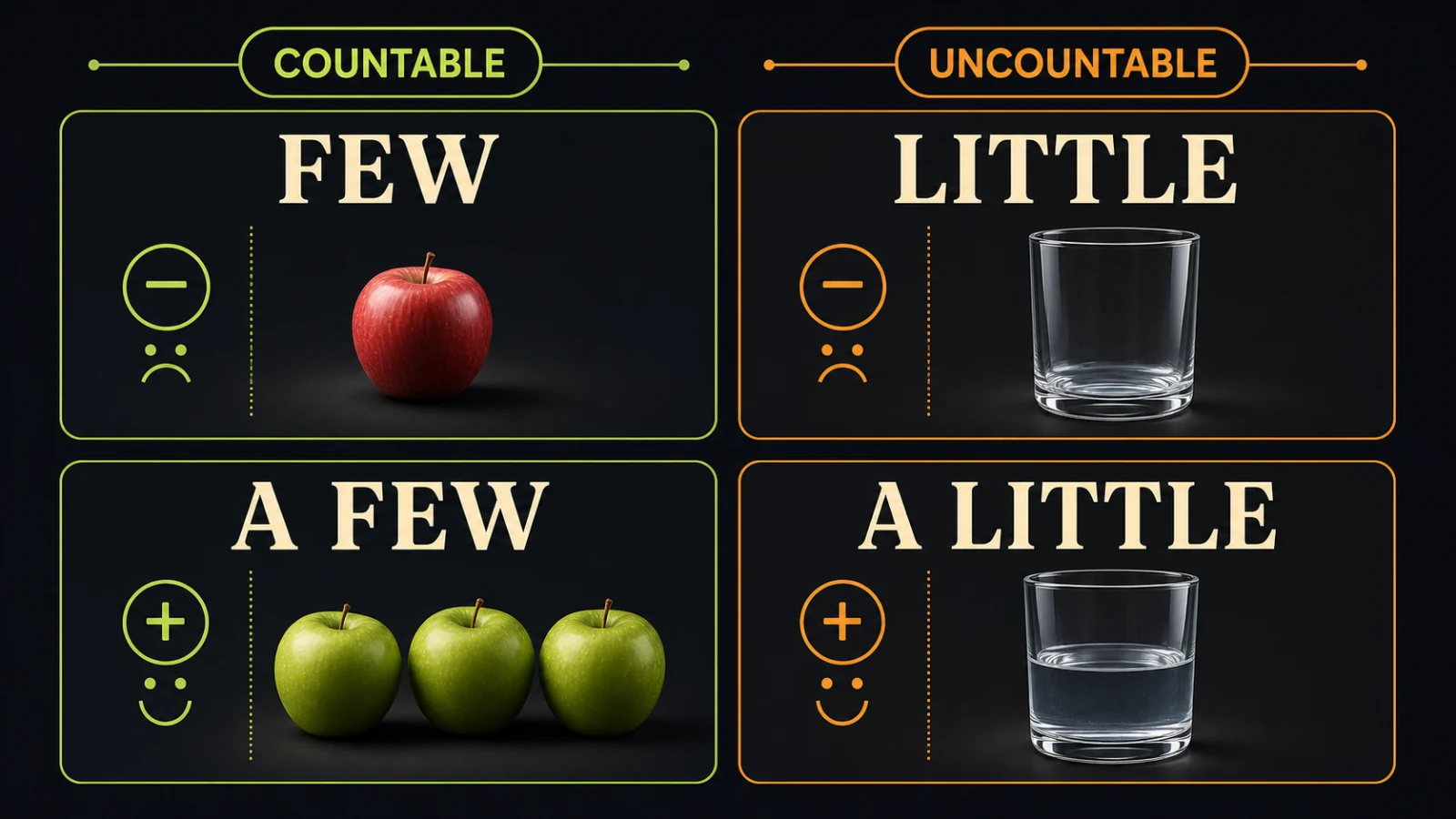
Think about apples and water. You can count apples: one apple, two apples — choose few or a few. You do not count water one by one — choose little or a little. The tiny a changes the meaning: without a, almost none; with a, some.
The whole rule in four cards
Blue and orange choose the pair. Red and green choose the meaning.
YOU CAN COUNT IT
You can count it: one book, two books → few / a few.
NOT COUNTED ONE BY ONE
You do not count it one by one: water, time, money → little / a little.
ALMOST NONE
Without a: few / little → almost none, not enough.
SOME
With a: a few / a little → some.
Question 1
Can you count it: one, two, three?
Try putting a number before the word. If the phrase sounds normal, use few or a few. If the substance or idea is not counted one by one, use little or a little.
YOU CAN COUNT IT
Count them: one apple, two apples; one friend, two friends → few or a few.
NOT COUNTED ONE BY ONE
Do not count them one by one: water, time, money → little or a little.
Count one by one
Few or a few? Compare them side by side
Both forms go with people and things you can count. The only difference is the tiny a.
ALMOST NONE
FEW — almost none, and that is a problem. I have few friends here. Almost no friends are here, and I feel lonely. Few students understood. Almost nobody understood.
SOME
A FEW — some exist, and that is good. I have a few friends here. Some friends are here. A few students understood. Some students understood.
Do not count one by one
Little or a little? Compare them side by side
Both forms go with water, time, money, and other things you do not count one by one. Here too, a changes the meaning.
ALMOST NONE
LITTLE — almost nothing is left, so it is not enough. We have little time. We must hurry. There is little milk left. It is almost gone.
SOME
A LITTLE — there is some, and it may be enough. We have a little time. Some time is available. There is a little milk left. Some milk remains.
Cheat sheet
Choose the word with two questions
Do not try to remember all four words at once. Answer the first question, then the second.
YOU CAN COUNT IT
1. Can you count it? Yes → choose few or a few. No → choose little or a little.
ALMOST NONE
2. Almost none and not enough? → few or little.
SOME
3. Is there a small number or amount? → a few or a little.
Common mistakes
Three mistakes that are easy to avoid
Look at the English noun, not only at its translation. In English, money and information are not counted one by one, but people are.
NOT COUNTED ONE BY ONE
Not a few money. Say a little money: there is some money.
NOT COUNTED ONE BY ONE
Not a little people. Say a few people: you can count people.
NOT COUNTED ONE BY ONE
Not few information. Say little information: information is not counted one by one.
Tiny quiz
Check yourself with four examples
First cover the part after the arrow and choose the word yourself. Then uncover the answer and read the simple reason.
SOME
I have ___ questions. Can you stay? → a few: we can count questions, and there are some.
ALMOST NONE
There is ___ milk. We need to buy more. → little: we do not count milk one by one, and almost none is left.
SOME
We have ___ time for coffee. → a little: we do not count time one by one, but there is some.
ALMOST NONE
___ students passed. The teacher is sad. → few: we can count students, but almost none passed.
What to do next
One last time: apples, friends, and questions can be counted, so use few or a few. Water, time, and money are not counted one by one, so use little or a little. Without a means almost none. With a means some.
Two questions lead you to the right answer.
Now practise the rule
Open few, little, and a little, listen to the pronunciation, and save the words. Review them with short flashcard sessions in the app.